
About the Unit
About the National Science and Technology Policy
Royal Decree No. (8/M), dated 19/4/1406 AH, directed King Abdulaziz City for Science and Technology, in the first of the duties set out in its statute, to «propose the national policy for the development of science and technology, and to draw up the strategy and the plan required to implement it».
This national direction was further consolidated in the Fifth (1410–1415 AH) and Sixth (1415–1420 AH) Development Plans, both of which called for accelerating the preparation of a comprehensive, long-term national plan for science and technology in the Kingdom of Saudi Arabia.
The following figure illustrates the goals set for the National Science and Technology Policy:
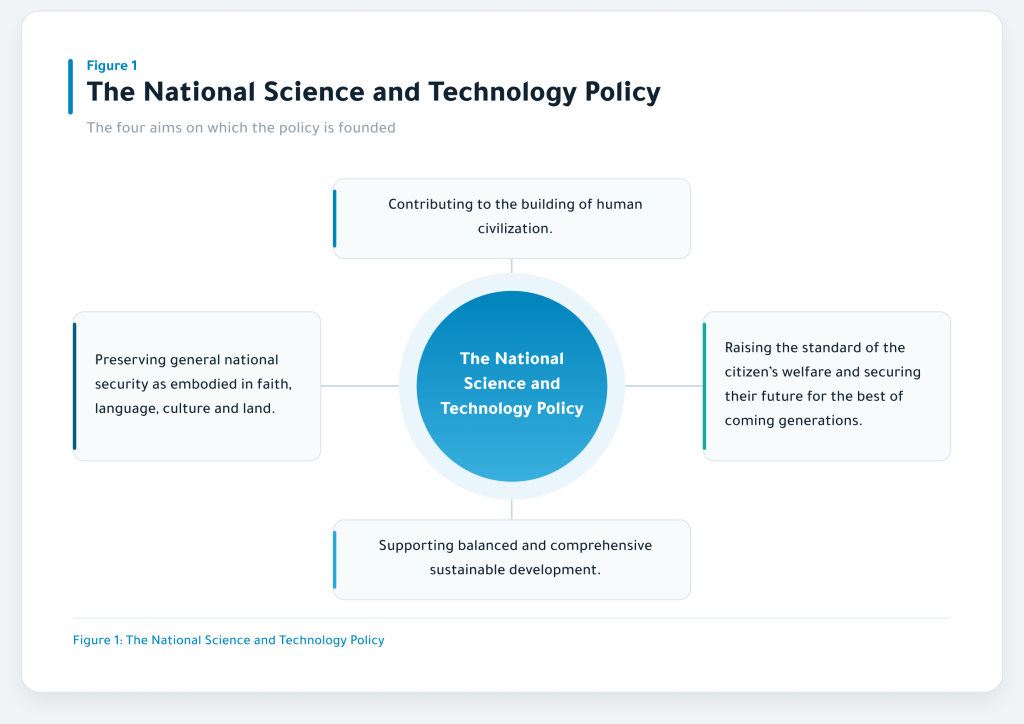
Activating this national policy, however, depends on establishing a national system for science, technology and innovation capable of localizing technology, developing it and cultivating it — in a way that serves the various development sectors and strengthens their competitive capabilities, and capable also of making optimal use of the opportunities offered by today’s rapidly changing global economy.
Creating an advanced national system requires building the scientific and technical capacities and capabilities, strengthening them, developing them, and directing them toward national priorities and needs.
The National Science, Technology and Innovation Plan
In implementation of the High Royal Decree, King Abdulaziz City for Science and Technology, in cooperation with the Ministry of Planning and the relevant governmental and non-governmental bodies, prepared the comprehensive long-term National Plan for Science and Technology. This required forming a preliminary committee from the City and the Ministry, which worked on developing the initial concepts for the mechanisms of preparing this plan and its various requirements.
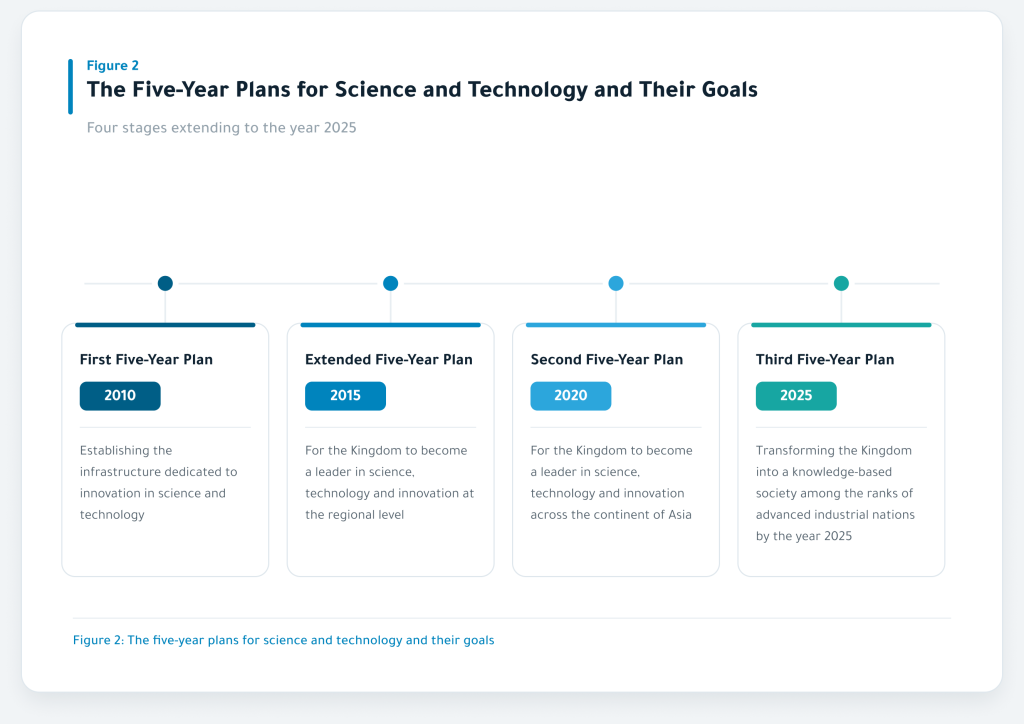
In light of this, it was determined that the best way to deliver the Kingdom’s comprehensive long-term National Plan for Science and Technology was to set its duration at twenty years, from 1420/1421 AH to 1440/1441 AH, corresponding to 2001 to 2020.
The plan contains the general strategic framework, with all it comprises of long-term objectives, policies and strategies for science and technology. From this framework emerge the science and technology programs and projects that are incorporated into the operational plans of government agencies, which are prepared in accordance with the methodology for preparing development plans, and within their framework and resources.
The following figure illustrates the various five-year plans and their objectives:
The National Science, Technology and Innovation Plan Program at King Saud University
King Saud University devotes all of its scientific and technical capabilities to keeping pace with the State’s strategic directions in the fields of science and technology, as defined by the Comprehensive National Plan for Science, Technology and Innovation, through which the Kingdom seeks to meet current and future scientific and technical challenges and to rise to the standing that befits it scientifically and technically.
To that end, the University mobilizes the scientific and technical capacities and capabilities, strengthens them, and directs them toward national priorities and needs. It also develops the systems and the infrastructure for scientific research and technical development, and works to provide a suitable environment for creativity, innovation and progress.
For this purpose, the University established the National Science, Technology and Innovation Plan Program, and a vision, a mission, objectives and mechanisms for achieving those objectives were defined as follows:
Vision
A leading model in achieving the objectives of the National Science, Technology and Innovation Plan.
Mission
Strengthening the scientific research system within the University in order to achieve the objectives of the National Science and Technology Plan, by encouraging researchers to contribute distinguished research projects, directing their interests toward the priorities of the plan, and activating their scientific output within the vital industrial sectors.
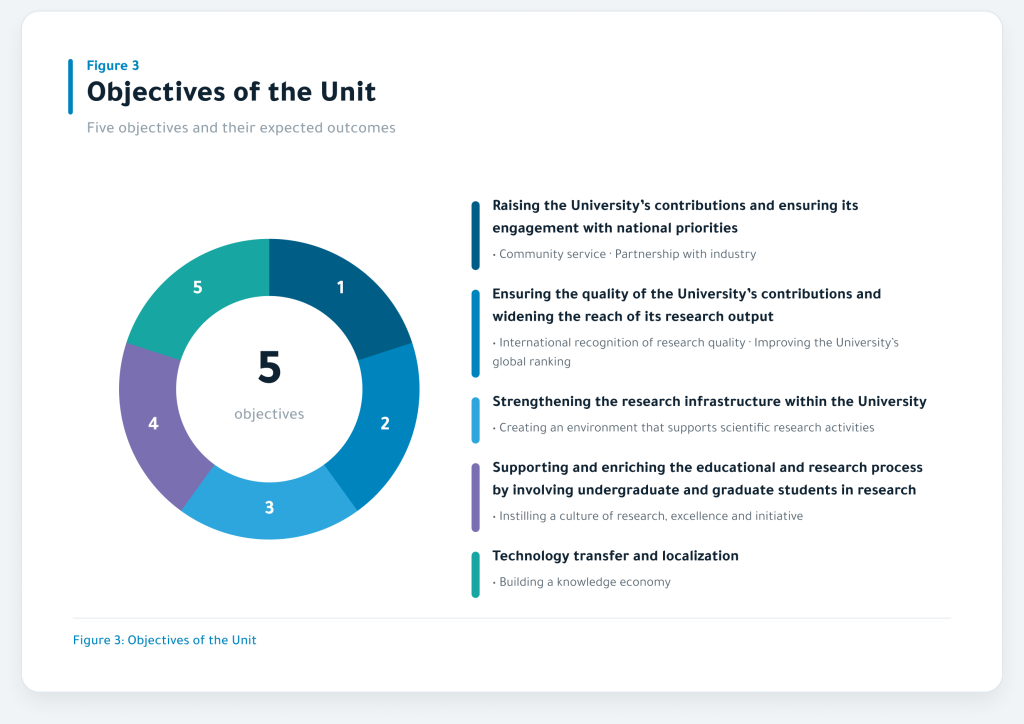
Objectives
Technology transfer and localization.
Increasing the University’s contributions in volume, and ensuring their consistency with the priorities and directions of the National Plan.
Ensuring the quality of the University’s contributions.
Broadening the reach of the scientific output of the research.
Strengthening the infrastructure for scientific research within the University.
Supporting and enriching the educational and research process by involving undergraduate and graduate students in the research.
Mechanisms
Periodic workshops at the University to introduce the National Science, Technology and Innovation Plan.
Continuous communication with researchers through the University newspaper, the program website, email, and short messages (SMS).
A scientific committee to evaluate research proposals and to ensure their quality and their conformity with the priorities of the various research programs.
A financial committee to follow up on the disbursement of financial entitlements in accordance with the approved budget for each project.
An annual multidisciplinary symposium to present the most important results of the supported research projects.
An electronic portal that includes:
An electronic system for receiving research, following it up and reviewing it.
An electronic system for verifying the originality of research and reports.
A website for displaying technical reports and published scientific papers.
A periodic scientific bulletin containing abstracts of scientific papers published within the research supported by the National Science, Technology and Innovation Plan Program.
Funding the registration of patents.
Financial incentives for publishing in internationally indexed scientific journals (ISI).
A commitment by researchers to involve graduate students in completing the projects.
A commitment by researchers to hand over the equipment they used in implementing their completed projects to the University’s laboratories.